

By Nicholas Beasley
Trees command our attention and did the same for the ancient people who wrote the Scriptures. They too found trees beautiful, valued their shade, and were impressed by their height and strength. Trees appear in the Bible from its first pages to its final chapter, both in their own right and as images for considering God and of humanity. The first creation story in Genesis stresses God’s provision for humanity: “I have given you every tree with seed in its fruit; you shall have them for food.” In the second creation story, humanity is settled by God in a garden containing a tree of life and a tree of the knowledge of good and evil. You may recall that the first humans were more interested in the knowledge tree than the life tree. Abraham received the Lord in the shade of the oaks of Mamre; Solomon brought cedars from Lebanon to panel the Temple.
The Cross is spoken of as a tree in Scripture, hymns, and poetry. In Acts 5, Peter spoke of the Lord’s saving death, saying that he was “killed by hanging him on a tree,” language informed by Deuteronomy’s teaching that everyone who hung on a tree was cursed. The Lord accepted the fate of the condemned for our sake. Early Christian writers loved this image, recognizing that a tree could be an instrument of death but was, more fundamentally, a symbol of life. Bishop Venantius Fortunatus took up the theme in sixth-century France. His Good Friday hymn “Sing, My Tongue, the Glorious Battle” (no. 165) speaks of the Cross as the “one and only noble tree; none in foliage, none in blossom, none in fruit thy peer may be.” It goes on to ask the tree, as cross, to show mercy: “bend thy boughs, O tree of glory,” relaxing its rigid sinews to cradle gently the Lord’s body in his redeeming work. The dying Lord Jesus is the fruit the hymn writer speaks of; a symbol of death has become a sign of life.
So much can be, and has been, written about trees in the Bible. Remember the shoot from Jesse’s stump, and Christ’s parables, with their fig trees, mustard seed trees, and good and bad fruit. The theme culminates in the Revelation to St. John, who saw a river of living water, with the tree of life growing on both sides, bearing fruit every month, its leaves for the healing of the nations. This is Revelation 22, the last chapter of the book, where the Holy Spirit takes the reader of Scripture back to Eden, which means “delight,” promising that what God will do in the end will surpass what he did in the beginning. Lovers of trees can indeed find them as images and witnesses of God’s work from the beginning of Scripture to its end.
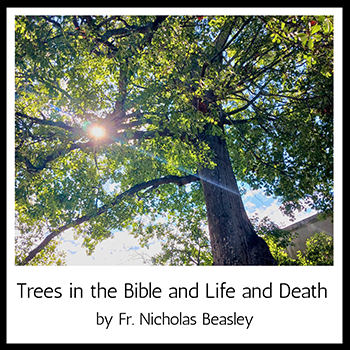
St. John’s ministry is rooted at the corner of Wheat and Holly Streets, a site that has hosted many trees over our congregation’s 114-year history. Early pictures of Shandon look like the prairie; later pictures of the church show trees that nearly hid it. We are now blessed to be in a neighborhood with lovely trees, and with a city administration that keeps planting more. But I have unwelcome news to share: our biggest water oak has fallen under the arborist’s judgment. It stands by the main rear door to Heyward Hall and is certainly older than our congregation. We’ve had it evaluated every few years, often after it dropped a large limb. This time the arborist said the time had come: for everyone’s safety, the tree needs to be removed in early October.
We will all miss it. Its shade made outdoor worship bearable during the pandemic. It shields my car from the sun’s broiling heat and makes outdoor conversation possible in the summer. Be sure that we’ll plant another tree once the stump is ground; in fact, the oak is already surrounded by seedlings, which will likely keep popping up for years to come. Take one home if you’d like to treasure our oak. Life is a miracle, impossible to stop, even when one particular manifestation of it reaches a natural end. Let’s give thanks for our mighty oak, which has spoken of a God of strength, beauty, provision, and redemption in its generation. We can be sure that God will raise up a successor to do the same.
Learn more about other important updates in the latest church newsletter: The Epistle – September 10, 2026